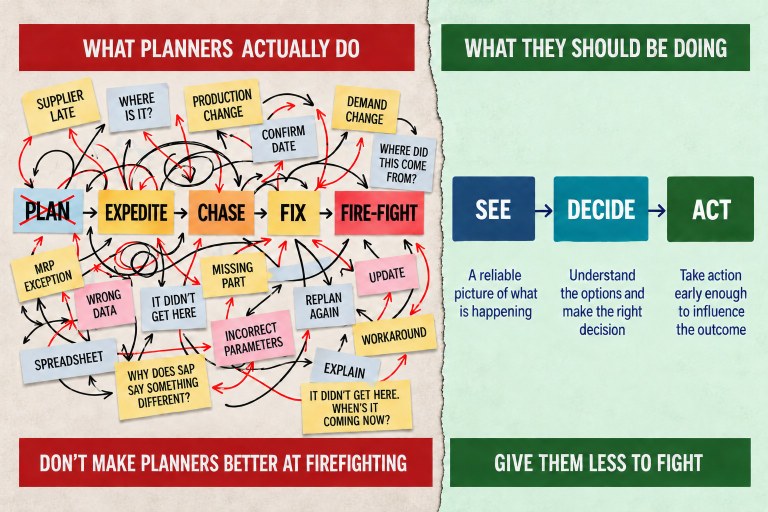
They’re spending their days asking:
- Where is it?
- When is it coming?
- Why does SAP say something different?
- It didn't get here. When's it coming now?
- Where did this come from?
And somewhere along the way, we’ve decided that this is just what planners do. It isn’t. Somehow people who should be planning the business have become administrators of instability. This is expensive because you’re paying professional people to compensate for problems that should have been designed out of the process.
The question isn’t: “Why aren’t our planners more productive?” It’s: “What have we built around them that prevents them from actually planning?”
Your planners were hired to plan
Planning supply. Balancing demand and supply. Identifying constraints. Making decisions about what needs to happen next. That is where their value should be.
Instead, many professional planners spend their days dealing with what has already gone wrong. They chase suppliers, investigate discrepancies, work around master-data problems, reconcile spreadsheets, investigate shortages and explain why SAP is "wrong". Too much of their time is spent around the system, outside the system, or reacting to problems the system should have helped them see earlier. The planner becomes the human integration layer between the business, the data, SAP, suppliers, operations and reality.
That may keep things moving. But it leaves very little time for the planning that should be happening.
So how did it go wrong?
It isn't a planner problem. It's an organisational capability problem that eventually lands on the planners.
At go-live, people are taught how to transact in SAP. They learn how to put information in and complete the transaction. They're rarely taught to check the result, fix what is going wrong now, and then stop it going wrong again. That lack of correction results in poor-quality data. Poor data creates noisy MRP. Noisy MRP creates too many exceptions, which are ignored. Too many ignored exceptions result in firefighting. Firefighting creates workarounds, spreadsheets and more manual intervention.
The more this happens, the less confidence people have in the system. So they intervene even more, still without correcting the system. And then we have a plan in SAP, plans in Excel, plans in people's heads, plans in emails, and planners scurrying around trying to pull it all together. Expediting is the consequence.
Stop Making Planners Expeditors
The answer isn't necessarily another planning tool or more people, and it certainly isn't simply telling planners to be more productive.
Things will go wrong. Demand will change. Suppliers will be late. Something will fail. Priorities will shift. It’s all pretty normal. The job of the professional planner is to identify what genuinely needs attention, understand the implications, make a decision, and act early enough to influence the outcome. And for that everyone needs to be working towards one plan.
That requires people to trust the information they're working with, understand what the system is telling them, and know what to do when it isn't telling them what they expect.
SAP should help with that
SAP should help professional planners see what is happening, understand what needs their attention, and act on it. But that only works if everyone has the capability and confidence to interpret what the system is telling them and deal with what is going wrong. So the answer is to remove the conditions that are creating multiple versions of the truth:
- Get the skills right,
- the data accurate,
- the parameters appropriate,
- everyone working on one plan, and
- MRP quieter.
Because the objective isn't to make planners better at firefighting. It's to give them less to fight.