Waste Creates Cost. Firefighting Hides It.
SAP does not create operational waste on its own. Once reactive behaviour becomes operational culture, inefficiencies scale quickly across the organisation. And the costs of this reactive behaviour are quietly absorbed into overtime, expediting, downtime, excess inventory, lost productivity, duplicated effort, and operational instability. Eventually, organisations stop seeing these costs as waste and start accepting them as “normal operations”.
Supply chains are trying to solve operational instability with AI, automation, and more technology. But reactive behaviour cannot be automated into stability. What is needed is cleaner data, more stable planning signals, better departmental integration, reduced manual intervention, and greater trust across all facets of operational execution.
Until then, supply chains will continue optimising firefighting instead of execution.
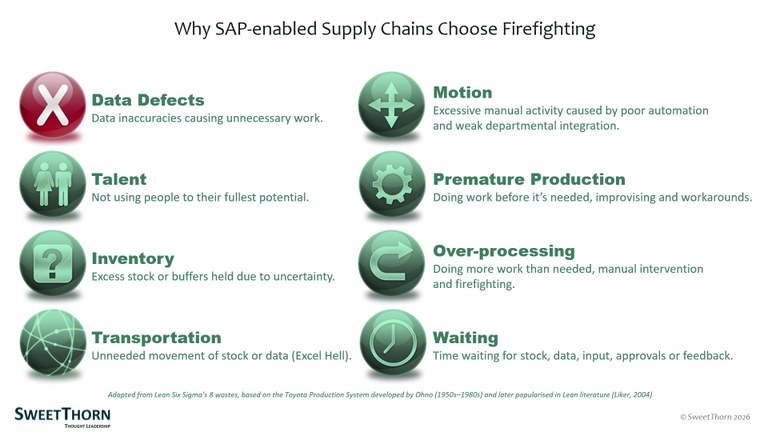
Examples of behaviours and hidden costs associated with each waste can be explored below:

Incorrect lead times, ill-conceived MRP parameters, no or inaccurate forecasting, and unreliable transactional discipline all distort planning signals inside SAP-enabled operations.
MRP logic does not correct these defects. It amplifies them into operational activity.

Highly skilled supply chain practitioners often spend their days chasing information, manually intervening, second guessing system outputs, or working around data defects rather than fixing them.
Instead of focusing on value-adding execution, people become administrators of supply chain instability.

Supply chains begin protecting themselves with inventory. Stock arrives before it’s needed, buffers and dead stock grow, warehouses fill up, and working capital gets consumed while instability remains unresolved.
And then suddenly, there is too much of the wrong stuff and not enough of the right stuff.
Supply chain practitioners begin moving data more than material. Emails, spreadsheets, screenshots, and manual exports increasingly become poor substitutes for operational integration.
This often appears as:
- Second guessing the system
- Repeated approvals
- Cross-functional chasing
- Disconnected workflows
- Excessive transactional effort
More effort goes into managing instability than improving execution.
Material planning behaviour increasingly gets hijacked by operational urgency. Supply chains begin responding to pressure instead of solid demand signals.
The result is increased inventory cost, excess stock exposure, and obsolescence risk.
Reactive activity increasingly takes the form of:
- Expediting
- Re-planning meetings
- Manual overrides
- Spreadsheet reporting and reconciliation
- Justifying stock outs
- Constant escalation to resolve operational disruptions
Teams spend more time managing reactive activities than managing execution. This is firefighting, which is not the waste itself. It is what waste looks like in execution.

Execution slows down when information or stock is late, approvals stall, stock visibility is poor, or departments operate in silos.
Delays increase downtime risk, disrupt execution reliability, and force supply chains deeper into reactive behaviour.